The WIndows
Repairing and Protecting the Windows
A Special Review of the Northwest "Usher" Window by Catrin Meredith
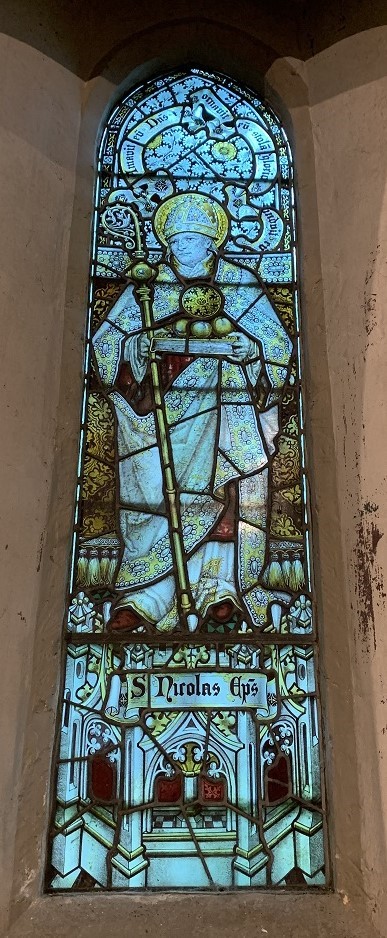
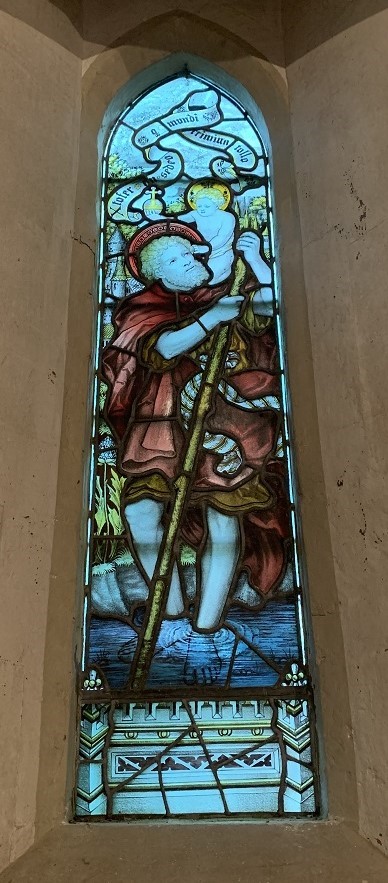
St Augustine's has a number of historic stained glass windows
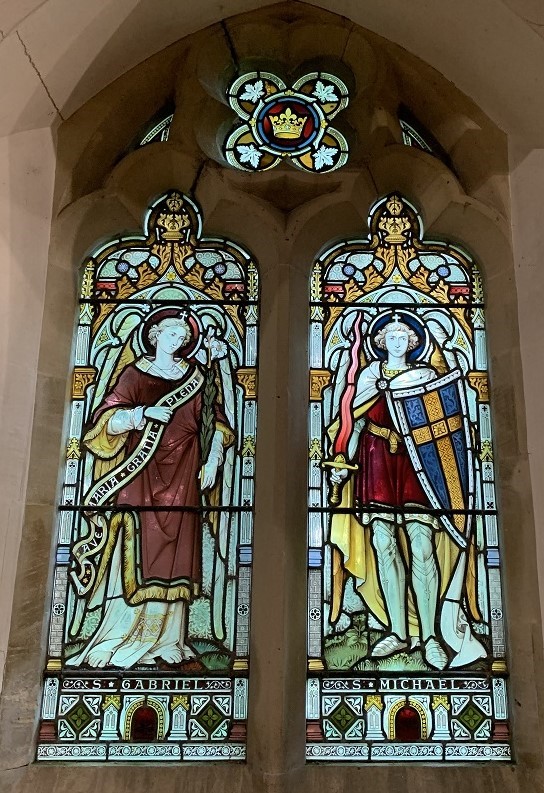
The lancet windows in the sanctuary and the window in the North wall of the chancel are 13th century - the glazing by the Victorian C E Kempe, one in memory of Percy, the eight Baron Barrington who died in 1881
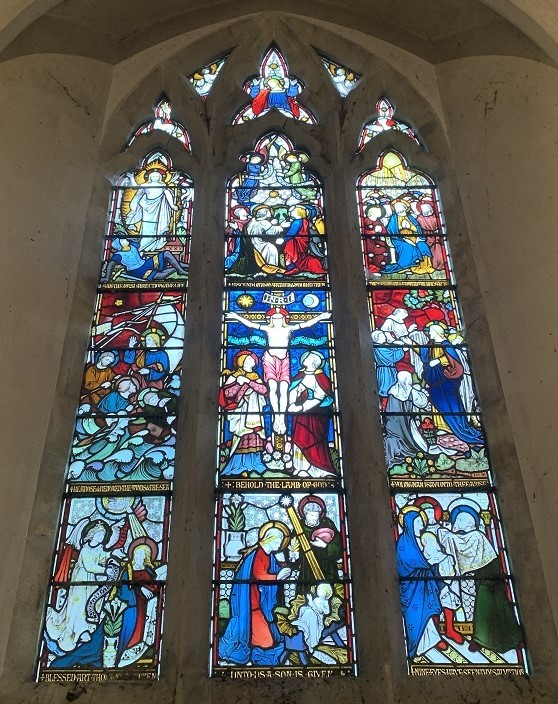
The East window is by Clayton & Bell and is pictured below
The West window is 19th century by Hardman
In the south wall there is a window dedicated to Jane Elizabeth, Viscount Barrington, who was born in 1804 and died 79 years later
The window in the south wall of the vestry was re-arranged in 1981 from fragments of medieval glass
A Special Review of the Northwest "Usher" Window by Catrin Meredith
The window located in the northwest corner of St Augustine of Canterbury church is the work of British artist Joyce Meredith (1892-1962). There are scant records of her life and artworks, and those details that do exist are scattered across various diocesan, convent and art school archives.
What we do have though is a handwritten list (possibly by her, or dictated by her) of windows she created, which includes ‘Window for S Augustine’s Westbury. Bucks’, in the archive of Mucknell Abbey in Worcestershire.
The faculty for the window1, found in the Oxfordshire History Centre, and lodged in May 1924 also confirms that ‘Miss Meredith’ was the artist, with the window being paid for by private subscription. It is likely, but not certain, that the Ussher family would have paid for this memorial window to two of their sons, with Rev Richard Ussher being the incumbent in the parish of Westbury at that time (between 1897 and 1928). Included with the faculty papers is Joyce Meredith’s sketch of the proposed window, containing the Angel of Peace and Our Lord the Prince of Peace, with ‘roses, lilies, red pricks and gentians’ to be found growing at their feet.
The window was probably in preparation at least by November 1923, as details in the Glass House letter book2 (part of the archives held in the V&A) from director A J Drury to Miss Meredith read ‘I am glad to hear you have another window coming along. Our charge for cutting leading firing and all material as usual for the 2 lights 4’-0” x 16” and one small piece of tracery would be £18-15-0 exclusive of packing carriage and fixing in church.’ The final cost for the window, within the same archive’s Cash book3 for August 1924 is given as £21-19s-2d. A further letter4 from A J Drury dated 18th August 1924 reads ‘I am glad to know the people at Westbury were delighted with the window.’
Born in 1892 in Liverpool, Joyce Meredith was educated at boarding schools in North Wales and Southport (the latter her aunt’s establishment) rounded off by a stay in Lausanne in 1910. Her father died from TB when Joyce was not quite four years old, and her mother spent most of the subsequent years abroad for her own health, before dying when Joyce was 14. The first known reference to art occurs during Joyce’s time in Lausanne, where she ‘studied drawing under M Alois Ottl’. On her return to the UK in 1911 she enrolled at Liverpool School of Art, where the brief entry in the student admission register records that in 1913-14 she took ‘Illum.: stained glass’ and in 1914-15 ‘stained glass’5. Already as a student she received her first commission for a stained glass memorial window, and a second WW1 memorial window followed in 1917. It was probably whilst a student in Liverpool that she first encountered Anglican nuns, boarding6 in Toxteth at St Margaret’s Hostel (an establishment with founding links to the All Saints Sisters of the Poor in London and the community based at St Thomas the Martyr in Oxford7, both of which orders Joyce would go on to spend periods of time working with).
By 1918 Joyce herself had entered the Convent of the Epiphany in Truro, and whilst there is evidence that she continued to produce other artworks, there were no more stained glass windows until after she had left the order before taking her final vows, in 1922. It would not be the last order she entered though, somewhat unusually. In 1924 on the Westbury Faculty papers she was listed as living on Bolsover Street, London, but by late 1924 she was spending time in a closed convent in Burnham, south Buckinghamshire, the Congregation of the Servants of Christ, where she subsequently took final vows and remained until 1940. She re-entered a further order, the Society of the Salutation of Mary the Virgin, in Oxfordshire, in 1941, and remained there until 1952.
Most of her 17 known windows were produced during the mid 1920s to 30s, and although there is early evidence in family correspondence that she was making as well as designing a window, it is unclear later on whether she continued the physically demanding work of assembling the windows herself, or whether this was delegated to those employed at The Glass House studios in Fulham.
The memorial window in Westbury is closely linked to the parish as it commemorates the lives of two of the then-vicar’s sons, Richard and Robert Arland Ussher, as is clear in the dedication along the bottom of the window’s 2 lights. Much of St Augustine’s church, Westbury, bears witness to the tragic tale of the Ussher family, from the grave of their 9th and youngest child, Arthur Basil, who died in 1899 aged 7, to the wall plaque inside the church in memory of him and two of his older brothers, Beverly and Stephen, who both died on active service in WW1 (in Gallipoli 1915 and Givenchy, France 1914 respectively). In total of their 9 children, all 6 sons died before their parents, 2 of them in childhood. Poignant indeed is part of the inscription on the grave of Rev Richard and Mary Ussher in Westbury churchyard: “They protected and loved their children and their children’s children.”
In 1936 (probably in The Times) the obituary8 for the long-lived Rev Richard Ussher describes the idyll that was Westbury vicarage life, “But into this tranquillity great sorrow came. Two sons were killed in France [sic], […..] as sorrow succeeded sorrow the temper of the parents grew finer, like steel tried in the furnace.”
The choice of subject matter and texts in the stained glass memorial appear significant, i.e. the Angel of Peace and Our Lord the Prince of Peace, and the repetition of the phrase ‘at rest’ after both dedications, for these two men apparently troubled in the aftermath of war. Lieutenant-Commander Richard Ussher, DSO RN’s obituary in the Portsmouth Evening News, records that he died ‘after a long and painful illness contracted whilst on active service in the war’, and his father’s obituary in 1936, probably in The Times, records ‘a third died in 1922 as the result of Wartime wounds and exposure’. His death certificate records him as ‘of no fixed address’ perhaps hinting at yet greater troubles.
Robert Arland Ussher’s obituary however, in The Tablet (he converted to Catholicism) states that he died after an operation following a sudden illness, although it also refers to a general frailty of health and even ‘physical disability’. His father’s obituary in 1936, probably in The Times, records that ‘the eldest, unable owing to ill-health to take part directly in the War, died in 1923 [sic], partly as the result of overwork and overstrain in the War work that he accomplished as a civilian’ (although the fact that his year of death is incorrect does not inspire confidence in the accuracy of the rest of the information!) Robert’s death certificate does not suggest any link back to the War, but rather perhaps an inheritance of hyperthyroidism (his Aunt Grace Ussher was said to have died aged 35 from Graves’ disease9). His father’s ‘Family Register’ book, uploaded on Flickr, records rather bluntly that eight-year-old Robert was ‘inclined to bronchitis’, ‘eczema-asthma’ and ‘Requires to be treated very carefully, certainly not hearty’. Despite this and not being sent away to school with his brothers, he seems to have studied and travelled extensively, and is credited in his obituary as being responsible for drafting key documents in the service of the Foreign Office, notably the Proclamation of Poland’s Independence [October 1918].
How Joyce Meredith came to be commissioned to make the window is not known. Certainly many of her family were vicars, so it may be that a connection was established here. Joyce’s uncle, Rev John Hunter Watt (1879-1960), with whom she boarded when first a student in Liverpool in 1911 and a champion of the AngloCatholic movement, went to Lincoln College, Oxford and was born in the same year as Beverly Ussher. Rev Richard Ussher was at Exeter College, Oxford, his son Robert went to Wadham College in 1895, and Beverly also to Wadham in 1898; Stephen seems to have gone straight to Sandhurst after leaving St Edward’s School, Oxford, and it is not known whether Richard pursued studies or went straight into the army after school.
However, the most likely connection is suggested by jottings found in Rev Richard Ussher’s ‘Family Register’ book on Flickr, and suggests the AngloCatholic network as the means by which Joyce Meredith received the commission. Rev Richard Ussher’s first parish was in Ventnor, Isle of Wight where, as Curate-in-Charge in the parish of Godshill, the AngloCatholic ‘tin tabernacle’ church of St Alban’s was opened in September 188910 on the outskirts of Ventnor. Before this, the area was served by St Margaret’s Mission Church11. Again, from Rev Richard Ussher’s Family Register12 he records that his children Mary Josephine (1886-1964) and Richard Arland (1887-1922) were both baptised at St Margaret’s Mission Church in Ventnor. In addition, one of Mary Josephine’s baptismal sponsors was Sister Maude of East Grinstead. She is likely to have belonged to the Society of Saint Margaret13, founded in 1855. This group of Anglican sisters opened a home for "delicate children" in Ventnor, Isle of Wight in 1879. My theory, and it is only a hunch, is that Joyce Meredith was put forward for the Westbury window on a recommendation by connections within the Anglican sisterhood, perhaps via someone linked to the Community of the Epiphany in Truro, the House of Prayer in Burnham (also in Buckinghamshire albeit at the opposite end of the county), or even St Saviour’s Osnaburgh Square, St James’s [Home for Penitents] Fulham or St Thomas’ Oxford, all of which are briefly referenced for this period in the one-page of life history held by Mucknell Abbey for Joyce Meredith.
However it came about, the window is an arresting and vibrant memorial, full of warm and calm imagery, both a fitting tribute to two lives cut short and a lasting witness to the skill of the artist.
1 DIOC/1/C/5/1654(1).
2 V&A 2008/1/59.
3 V&A 2008/1/24.
4 V&A 2008/1/59.
5 LJMUH/SA/1/5/1/2.
6 Reference to exhibitors’ addresses in H 708.5 AUT: Walker Art Gallery, Autumn Exhibition: Illustrated Catalogues, 1913 – 1916
7 Janet Hollinshead and Pat Starkey, ‘Anglican Nuns Come to Liverpool’, Transactions of the Historic Society of Lancashire and Cheshire, 170 (2021), pp 117-118.
8 https://www.flickr.com/photos/isabel_maree/1720826312/in/album-72157630469313662
9 Flickr album of Rev Richard Ussher’s Family Register
Pictures
Repairing and Protecting the Windows
We have now started some work on our windows thanks for the kind support from our Friends organisation FOStA and also through supporters generating free cashabck through Easyfundraising.
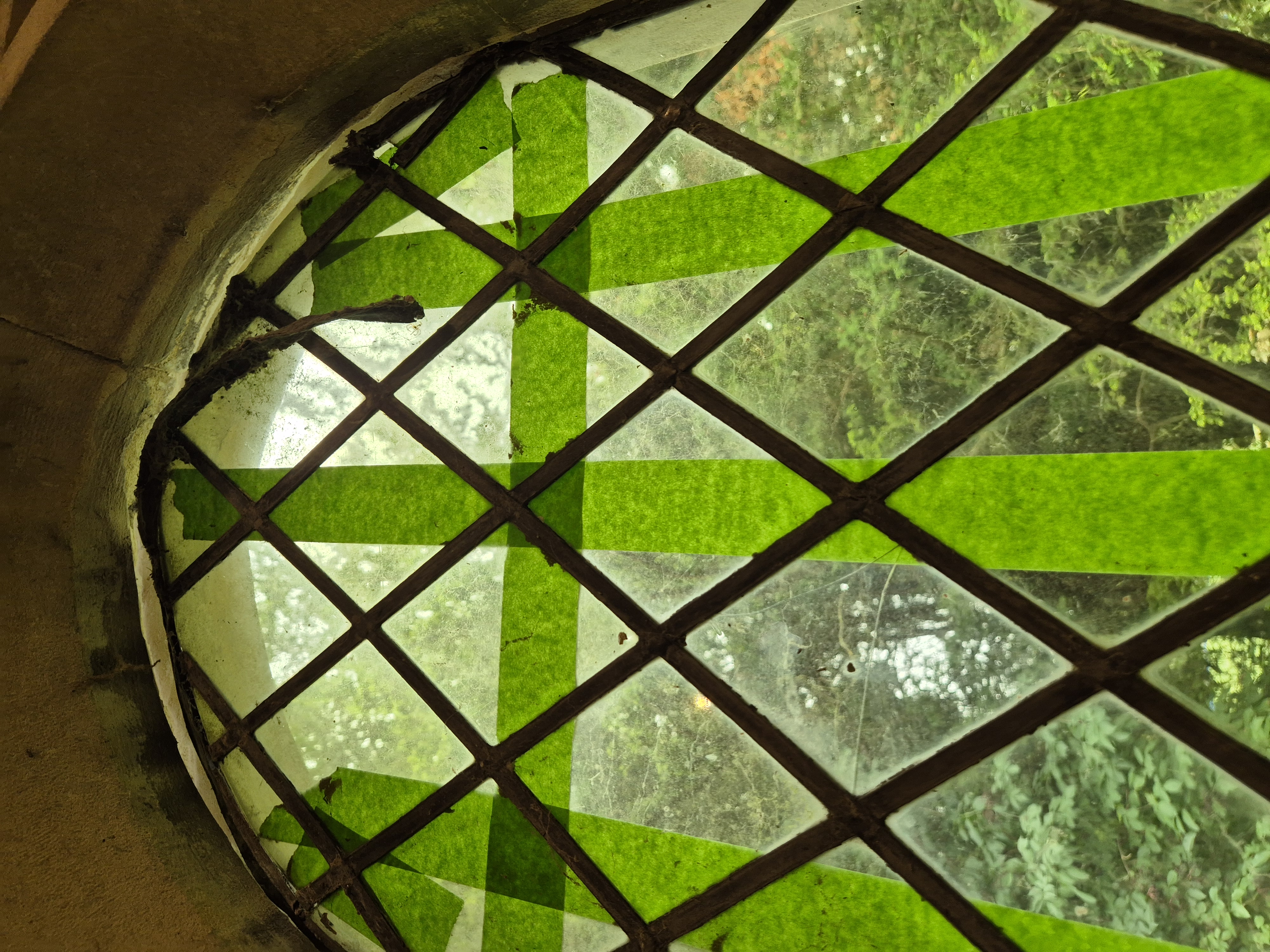
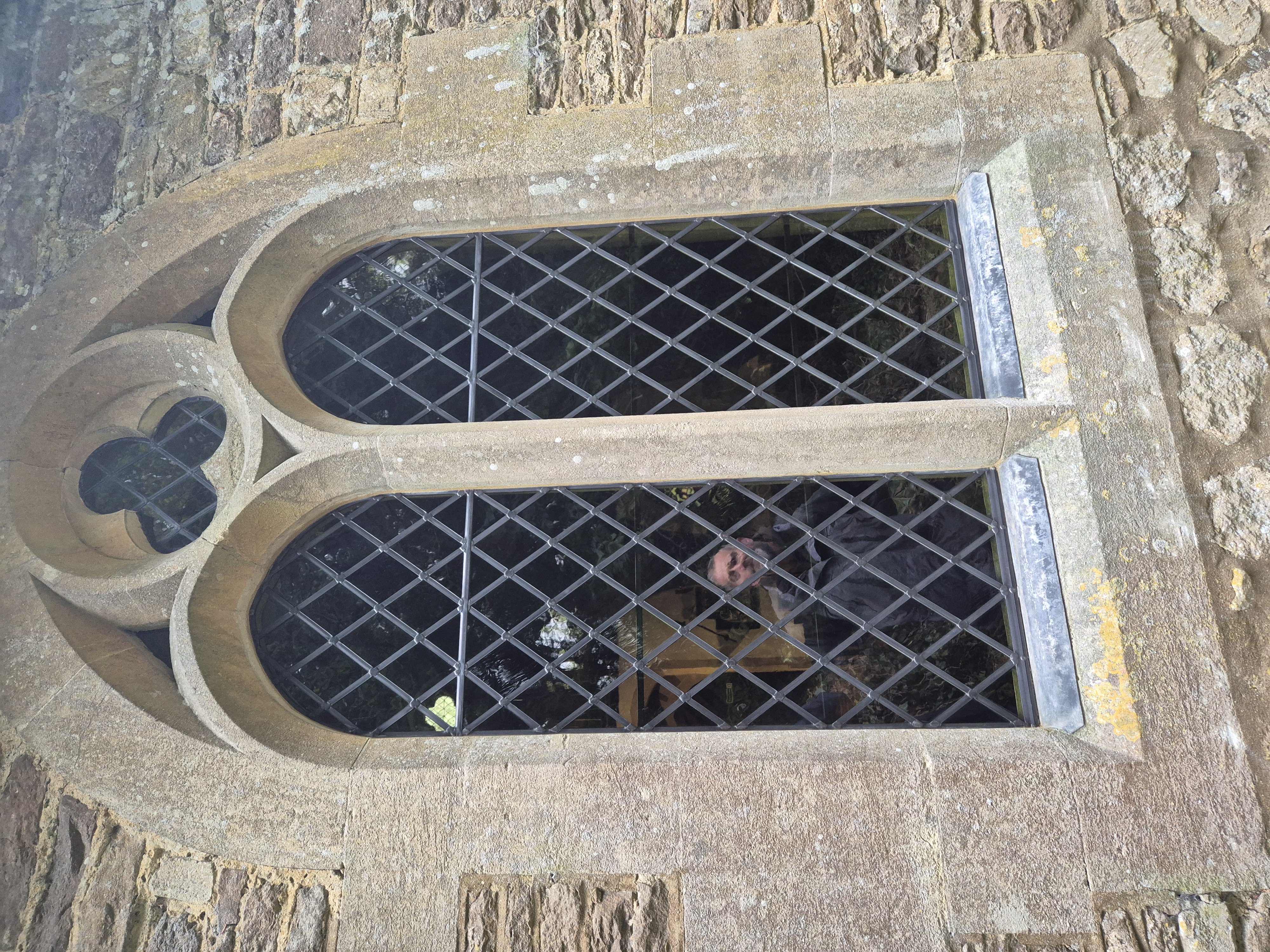
Lots to do and also fund raise for but it is a start. The first window was one at the rear that was in very bad condition (before and after). Some others have been restored thanks to a famly legacy but there is still more to do.
Your support would be truly appreciated
It costs over £20,000 each year to keep the church open and maintain the churchyard. If you are able to help at all, please click here or on the Parish Giving icon below. Thank you